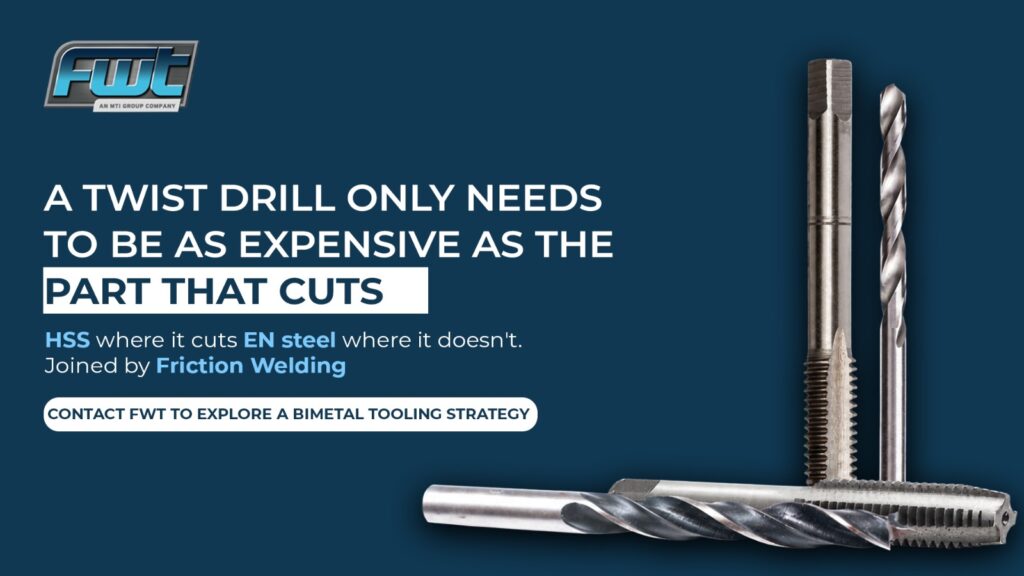
A twist drill only needs to be as expensive as the part of it that actually cuts. That single fact is reshaping how manufacturers approach drill bit production, and it is why friction welding has become a core process in the cutting tools industry. At Friction Welding Technologies (FWT), we build bimetal twist drills by joining a high-speed steel (HSS) body to a lower-cost EN-series alloy steel shank, using a solid-state process that delivers full HSS cutting performance without the full HSS cost.
Why Only Part of a Drill Needs HSS Material
A twist drill has two functional zones, and they carry very different demands. The body and flutes do the cutting. They need the hardness, wear resistance, and red-hardness (the ability to hold a cutting edge at elevated temperature) that only HSS reliably provides. The shank, by contrast, does no cutting at all. Its job is to sit in a chuck or collet and transmit torque. It needs strength and dimensional stability, not cutting-grade metallurgy.
Manufacturing the entire drill from HSS ignores that distinction. It puts premium alloy content into a section of the tool that never touches the workpiece.
The Cost Problem with All-HSS Drills
HSS is expensive relative to standard alloy steels, and it does not machine easily. Its high alloy content and hardness make grinding and turning operations slower and more tool-intensive, which adds cost and cycle time throughout production. That penalty scales with drill diameter: on larger drills, the shank represents a significant share of the total material volume, meaning a disproportionate amount of expensive, hard-to-machine HSS is consumed by a section of the tool with no cutting function.
Replacing that shank material with EN-grade steel, which is inexpensive and machines readily, addresses both problems at once. The challenge is joining the two materials without compromising the tool’s strength or straightness, which is where friction welding comes in.
Joining HSS to EN Steel Without Melting: Friction Welding
Friction welding is a solid-state process. One workpiece is rotated against the other under axial force, and the friction at the interface generates heat directly at the joint. The materials never reach their melting point. As the interface temperature rises, forging pressure is applied, and the bond forms metallurgically under pressure rather than through fusion.
For an HSS-to-EN twist drill blank, this matters because fusion welding techniques bring their own risks: melting and re-solidification at the joint can produce brittle phases, porosity, or a heat-affected zone (HAZ) wide enough to soften the HSS body near the weld line. Friction welding keeps the heat-affected zone narrow and keeps peak temperatures below the point where the HSS microstructure is degraded, which preserves the hardness and wear resistance the cutting edge depends on.
Weld parameters, rotational speed, axial force, burn-off length, and forge pressure, are set specifically for the HSS-EN pairing and the drill diameter being produced. Get those parameters wrong and the result is an inconsistent hardness gradient across the joint or a weld that cannot hold up to the torsional and axial loads a drill sees in service.
Quality Control for Bimetal Drill Blanks
A twist drill spins at a high RPM under load, so the weld joint has to meet requirements that go beyond simply staying bonded. Concentricity and runout at the joint have to fall within tight tolerances, since even minor misalignment translates into vibration, poor hole finish, and premature tool wear at speed. The joint also has to carry the torsional and axial forces of drilling without failure, which means torque and bend testing are standard steps in qualifying a weld schedule.
Hardness is checked across the joint, not just within the HSS section, to confirm the heat-affected zone has not softened the material adjacent to the weld line or introduced decarburization at the interface. Because the HSS portion still requires heat treatment to reach its final hardness, weld schedules and post-weld heat treatment are qualified together, not independently, so the joint retains its strength through the full production sequence.
Where Bimetal HSS-EN Drills Are Used
Bimetal twist drills produced with friction welding are standard practice across general engineering, automotive component manufacturing, and construction tooling, anywhere high drilling volumes make the cost difference between an all-HSS drill and an HSS-tipped drill add up quickly. The cutting performance at the point of use is unchanged. What changes is the cost structure behind every drill that leaves the shop floor.
The FWT Approach
We treat the HSS-to-EN joint as a qualified process, not a one-off weld. Every drill diameter and material pairing we run is developed against defined weld parameters, verified with hardness traverses and mechanical testing, and held to runout tolerances appropriate for a rotating cutting tool. That process discipline is what allows a bimetal drill blank to perform like a solid HSS tool while costing a fraction as much to produce.
The Bottom Line
Friction welding lets twist drill manufacturers put HSS exactly where it is needed and nowhere else. The result is a tool that cuts like solid HSS, costs closer to alloy steel, and holds up to the demands of high-volume production. Friction Welding Technologies brings the process control and joint qualification that make that combination reliable at scale. If you produce or specify HSS twist drills and want to explore a bimetal tooling strategy, contact our team to talk through your application.