Walk into an advanced manufacturing facility today whether it builds rocket tanks, high-speed trains, or electric vehicle battery trays and you will likely see a machine pressing a spinning tool into two pieces of metal, leaving behind a seam that looks almost polished. That is Friction Stir Welding in action, and it is quietly rewriting the rules for how we join metals. At Friction Welding Technologies Pvt. Ltd. (FWT), part of the MTI Group of Companies, this is the technology we design machines for, build production cells around, and contract weld.
Invented at The Welding Institute (TWI) in Cambridge, England in 1991 by a researcher named Wayne Thomas, the process was patented and licensed out over the following decade. Today, Friction Stir Welding sits behind some of the most demanding products on and off the planet, and FWT brings together machine building, tooling expertise through its partnership with STIRTEC, and contract welding services under one roof.
How FSW Actually Works
Here is the part that throws people off the first time they see it: there is no arc, no shower of sparks, no molten puddle. Unlike traditional fusion welding, the process never melts the base metal.
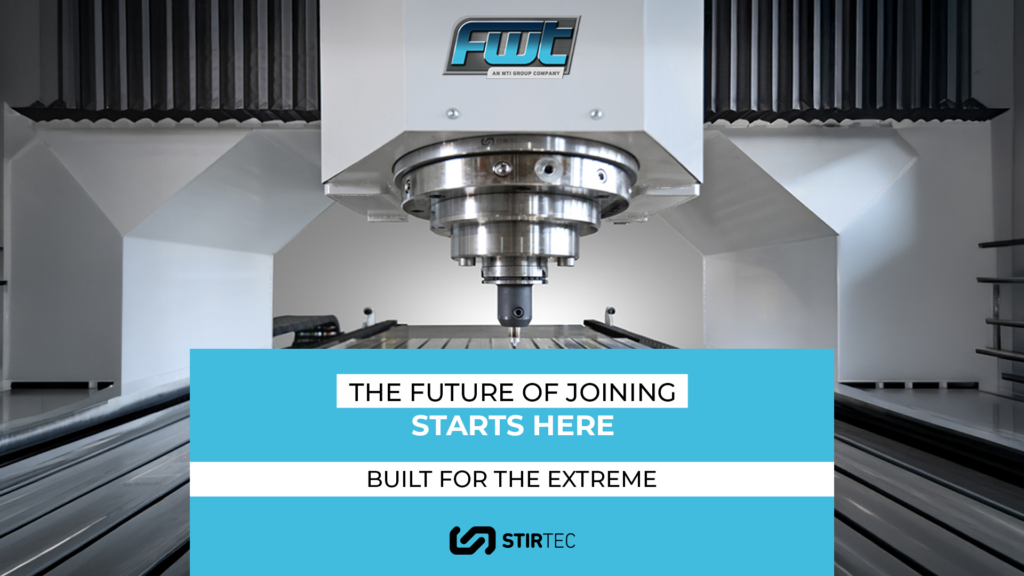
A non-consumable tool, usually tungsten carbide or a hardened steel alloy, has two key parts: a flat shoulder and a profiled pin. The tool rotates at high speed (typically 400 to 1,000 RPM for aluminium alloys) and is plunged into the joint line between two clamped workpieces. Friction generates intense heat, enough to soften the material to a plastic, dough-like state without pushing it past its melting point.
Once the metal is soft, the tool traverses along the joint. The shoulder forges the softened material down while the pin stirs it from one side of the seam to the other, mechanically mixing the two pieces into a single continuous structure. When the tool moves on, the metal cools and solidifies and you are left with a forged-quality weld. This entire process is governed by a closed-loop control platform that monitors force, position, and torque in real time, so weld quality stays inside ISO 25239 limits even on continuous production runs.
The Case for Solid-State Joining
Traditional arc welding is a brilliant, century-old technology, but it has its quirks. Melting metal introduces problems: porosity from trapped gases, cracking in certain alloys, warping from uneven heat, and weaker joints in high-performance aluminium grades. Most of those headaches simply disappear with Friction Stir Welding.
Because the metal never liquefies, you do not get gas porosity. You do not need shielding gas, filler rods, or flux. The heat-affected zone is narrower. Distortion is dramatically lower. And perhaps most importantly, Friction Stir Welding can join metals that conventional fusion welding really struggles with, particularly the high-conductivity aluminium and copper combinations used in EV battery enclosures, which tend to crack or form brittle intermetallics when melted.
There is also an environmental angle that is hard to ignore. No fumes. No consumables. No UV arc. No spatter. The process uses significantly less energy than arc welding, and because there is no filler material, scrap rates drop. In an era where manufacturers are chasing every last bit of efficiency, friction stir welding ticks a lot of boxes which is exactly why so many customers in the EV, aerospace, and rail sectors have switched.
Where You Will Find FSW and Where FWT Fits In
The aerospace industry adopted it first. NASA and its contractors use the process on the Space Launch System’s cryogenic fuel tanks, and SpaceX has publicly discussed using it on parts of its Falcon rockets. Airbus and Boeing employ it on fuselage panels and structural components. The Eclipse 500 business jet became the first commercial aircraft to use the technique extensively across its airframe.
Shipbuilders took it up too. The panels in high-speed ferries and naval vessels are often too large and too thin to weld conventionally without warping into potato chips. Friction Stir Welding keeps them flat which is why FWT’s LS Series machines, with their 3-axis weld capability and modular base, are configured specifically for long, continuous welds on wide aluminium extrusions and structural panel assemblies used in shipbuilding and high-speed rail.
Then there is automotive. As carmakers switch from steel to aluminium and even copper for electric vehicle battery enclosures, they have run headlong into the limits of fusion welding. Friction Stir Welding has become the go-to solution for EV battery tray manufacturing, where leak-tight aluminium joints are non-negotiable. At FWT, customers can validate their process, conduct welding trials, and access contract welding support on our equipment in Pune. When the application is ready for production scale-up, we also design and build machines tailored to the required axial forging forces and part geometry.
FSW Process Constraints and Considerations
It is not magic. The process requires heavy, rigid machinery the forces involved are significant, and flimsy setups produce poor welds. The workpieces need to be clamped firmly to a solid backing anvil. At the end of each weld, the retracting pin leaves a small exit hole, which usually has to be dealt with by running the tool off onto a run-out tab or by using a retractable-pin design. Tool wear can also be a challenge on harder metals like steel and titanium, which is part of why aluminium has remained the dominant application and why FWT invests heavily in tool material development through our partnership with STIRTEC.
Looking Ahead: Friction Stir Welding
Research is pushing Friction Stir Welding into new territory. Variants like friction stir spot welding are replacing rivets in car bodies. Bobbin-tool configurations eliminate the need for a backing anvil altogether. And friction stir additive manufacturing is emerging as a way to build up parts layer by layer, without ever melting the feedstock a potential game-changer for repairing expensive aerospace components.
Perhaps the most interesting frontier is dissimilar-metal joining. Because Friction Stir Welding works in the solid state, it can join aluminium to copper, steel to titanium, or magnesium to just about anything. As lightweighting pressures mount in transportation, that ability to mix metals is becoming genuinely valuable, and it is one of the areas where FWT’s engineering team spends a lot of time today.
For a process that most people outside manufacturing have never heard of, Friction Stir Welding has left a surprisingly large footprint on the world. The next time you board a plane, step onto a ferry, or plug in an electric car, there is a decent chance some of the metal holding it all together was joined by a spinning tool that never actually melted anything.
Getting Started with FWT
FWT is ready to take on your toughest welding challenges. Have a few questions? Let our team of experts take it from here.
LinkedIn: Click here to view our LinkedIn page.