
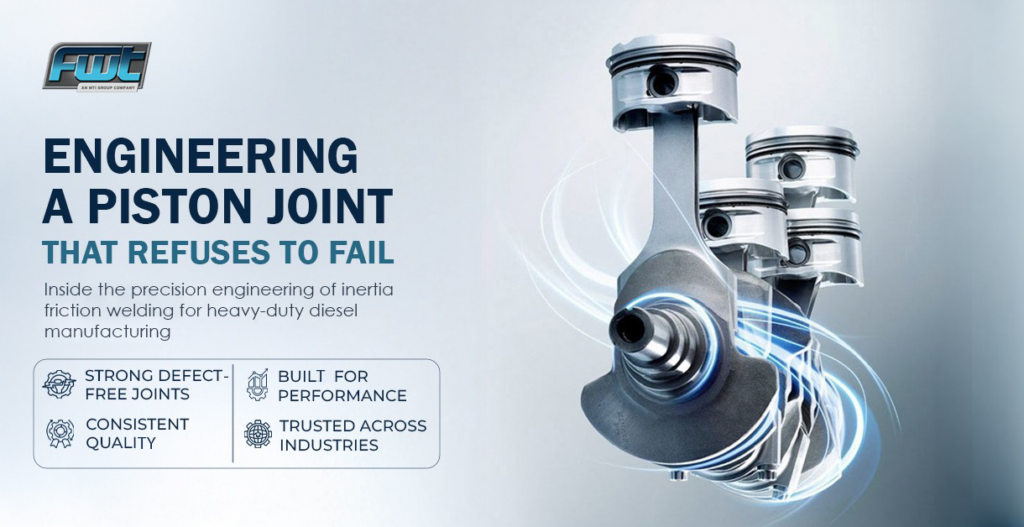
Inside a running diesel engine, a piston lives through violent cycles every second it operates. Combustion pressure can spike past 200 bar. Crown temperatures climb toward 400 degrees Celsius. This happens thousands of times a minute, for years, without a single pause. Somewhere in the middle of that cycle sits a seam, the exact line where two separate pieces of steel became one piston. If that seam were the weak point, the engine would not make it through its first long haul. It survives because friction welding a diesel piston assembly turns two separate parts into one dependable unit.
Friction welding diesel piston manufacturing is not a new idea, but it has become the standard way heavy-duty engine builders produce modern steel pistons. Instead of melting metal together like arc or gas welding, this process relies on motion and pressure. One component spins at high speed while pressed firmly against the other. The rubbing generates intense heat right at the contact surface, softening the steel enough to bond without turning to liquid. Once the interface reaches the right plastic state, rotation stops and a final forging force locks the joint solid.
This solves a real engineering problem. Piston crowns need tough, heat-resistant steel that can absorb combustion shock. Piston skirts need a material that manages friction against the cylinder wall while keeping weight down. Forcing one material to do both jobs means accepting a compromise. A friction welded diesel piston lets manufacturers pair a forged crown of one steel grade with a skirt of another, then join the two into a single, dependable part.
Friction Welding Process Parameters that Make or Break the Joint
Every successful weld comes down to a small set of numbers. The friction welding process parameters that matter most are rotational speed, friction pressure, friction time, and forging pressure. Get one of them wrong and the mistake rarely shows up on the factory floor. It shows up months later, inside an engine, at the worst possible moment.
Rotational speed controls how fast heat builds at the interface. Too slow and the joint never gets hot enough to bond properly. Too fast and the material can overheat, coarsening the grain structure exactly where strength matters most.
Friction pressure and friction time work as a pair, controlling how much material gets pushed aside during welding, a step often called “burn-off”. Too little burn-off can trap oxide or contamination inside the joint. Too much wasted material slows a production line turning out thousands of pistons a day.
Forging pressure is the final act. Once spinning stops, a stronger axial squeeze consolidates the softened steel into a dense bond free of hidden voids. Manufacturers tune these process parameters through repeated testing, then lock the settings into automated welding cells so every piston gets an identical joint. Dial in these numbers correctly, and a friction welded diesel piston can run for the life of the engine without anyone noticing the joint is there.
Inertia Friction Welding Steel: Why this Method Fits the Job
Most diesel piston production leans on inertia friction welding steel components, since pistons are round parts and rotation is the most natural way to spread friction evenly across a circular joint face.
In this setup, the crown is typically held still while the skirt spins against it under load. Because the geometry is symmetrical, heat builds evenly around the entire circumference, which matters for a part that must perform identically at every point around its diameter.
Steel suits this process well. It can be pushed into a soft, workable state without melting, then forged into a strong metallurgical bond the moment rotation stops. The steel grade chosen for friction welding diesel piston is typically 4140, a chromium-molybdenum alloy picked because its behavior under inertia friction welding is well understood and repeatable at an industrial scale. The result is a friction welded diesel piston with a joint as strong as the metal surrounding it.
Heat-Affected Zone Welding: Why a Narrow Zone Wins
Every welding process changes the metal near the joint, not only at the joint line itself. Engineers call that surrounding region the heat-affected zone (HAZ). Heat-affected zone welding damage gets close scrutiny because the zone can end up weaker or more brittle than the base metal if the process runs too hot for too long.
Friction welding has a genuine advantage here. Because heat only builds at the interface and the entire cycle finishes in seconds, the heat-affected zone in a friction welded diesel piston stays narrow compared to arc welding. Less time spent at high temperature means less grain growth and fewer unwanted changes creeping into the surrounding steel.
That narrow zone still gets checked carefully. Engineers map hardness moving outward from the weld line to confirm the steel returns to base metal properties, with no sudden brittle pocket waiting to crack under repeated combustion loading.
Piston Joint Integrity: Proving the Weld Can Take the Heat
None of this matters if the finished friction welded diesel piston cannot survive its job. Piston joint integrity gets verified through a mix of destructive and nondestructive testing before a design reaches full production.
Tensile testing pulls sample welds apart to measure strength against the base steel. Fatigue testing cycles the joint under repeated load, compressing years of combustion pulses into days inside a lab. Ultrasonic and radiographic inspection scan finished parts for internal defects without destroying a single piston.
Metallurgical cross sections finish the picture. Cutting through a sample weld and examining it under a microscope lets engineers confirm the bond line looks the way testing predicted it would. This is how piston joint integrity moves from a design goal on paper to a proven fact for every part that leaves the plant.
When all of this comes together, a friction welded diesel piston can handle millions of load cycles without that joint becoming the weak link. That is the real achievement here. Not a flashy piece of engineering, just a joint doing exactly what it was built to do, cycle after cycle, for the life of the engine.
Friction welding diesel piston manufacturing will only expand as emission rules push combustion pressures higher and engine builders lean harder on steel for its strength and resistance to thermal fatigue. The process itself stays quiet and unglamorous. It is also one of the reasons modern diesel engines keep running as long as they do.
Getting Started
FWT is ready to take on your toughest welding challenges. Have a few questions? Let our team of experts take it from here.
LinkedIn: Click here to view our LinkedIn page.